Top Signs You Need Garage Door Service – Don’t Ignore These
A garage door that takes two seconds longer to open than it did last spring isn’t just an annoyance. It’s often the first visible result of your opener motor working against increased friction, and left alone that extra strain is what shortens a motor’s life. Most homeowners wait for a door to stop working entirely before they call anyone. In our experience, the expensive repairs are almost always small symptoms that sat untouched for weeks. If you’d rather not spend a Sunday afternoon diagnosing it yourself, call (844) 325-8504.
Key Takeaways
- A two-second lag is an early warning, not a quirk. Time your door and note the change.
- Uneven gaps at the floor point to three different problems, and each needs a different fix.
- A door that lifts fine by hand but struggles on the opener usually means spring tension, not a bad motor.
- A sharp, snapping or popping sound from the cable area is a stop-using-it sound.
- New Jersey humidity and freeze-thaw cycles wear specific parts faster than milder climates do.
What does the “two-second lag” test tell you about your door?
The two-second lag test tells you whether your opener is starting to strain before anything breaks. You don’t need tools. Open your door with the opener and count the seconds from the moment it starts moving to the moment it’s fully up. Then do the same from fully open to fully closed. Write both numbers down. Repeat the test once a month and compare.
A door that has always taken fourteen seconds and still takes fourteen is fine. A door that used to take twelve and now takes fifteen is telling you something changed. That extra time is friction the motor has to overcome, and motors aren’t built to overcome much. They’re built to lift a balanced door with a little help.
Here’s what’s usually behind a growing lag:
- Dry or worn rollers that no longer roll smoothly in the track
- Hinges losing lubrication and binding at the joints
- Springs that have relaxed and are carrying less of the door’s weight
- A track that’s slightly out of alignment, adding drag along one side
Any one of these puts more load on the opener. More load means more heat, and heat is what kills motors. This is the reason a door that “still works” is worth looking at before the opener gives out. The lag test catches it while the fix is still small. Homeowners in The Heights who run this test once a month tend to catch problems while they’re still a lubrication or adjustment job.
What do uneven gaps at the floor actually mean?
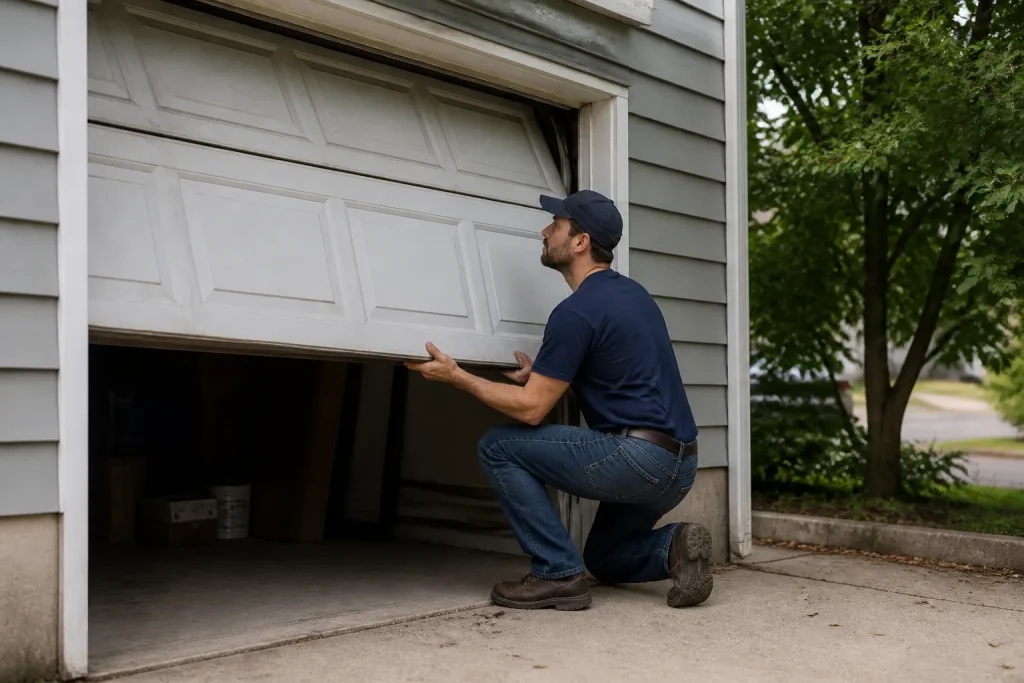
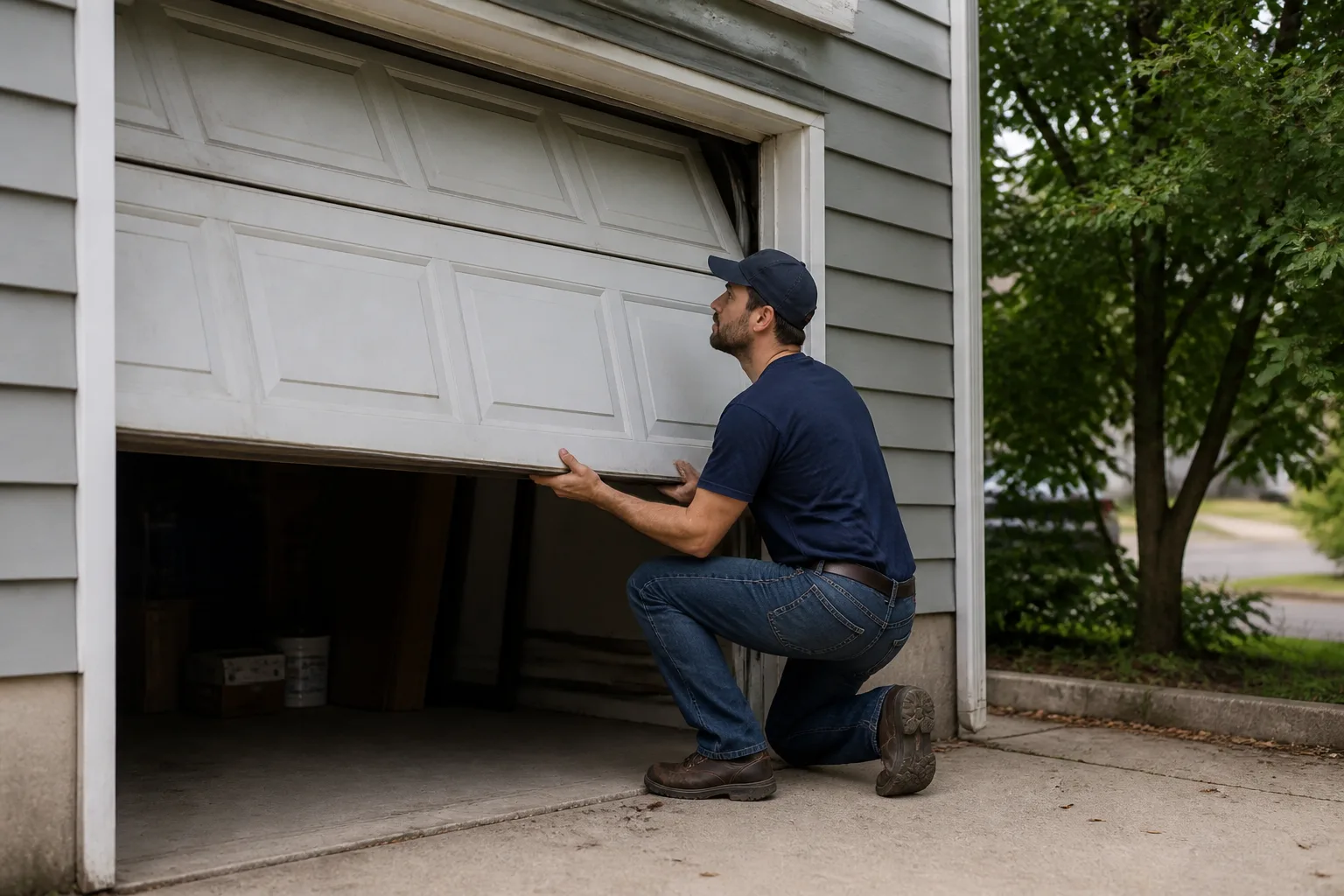
An uneven gap at the floor means the door isn’t sitting square, and the cause could be hinge wear, a bent track, or a shift in the floor or foundation itself. These are three different problems with three different repairs, and guessing wrong wastes money. The gap pattern is the clue.
A gap that’s wider on one side and narrow on the other usually means the door has settled on one side. That’s often a hinge or roller problem. The bottom section hangs slightly crooked because one side of the hardware is worn or loose while the other is still tight. The fix is hardware-level: replace the worn hinges, reset the rollers, adjust the track.
A gap that’s even across the width but taller than it used to be usually points to the door stopping short of the floor. That’s a travel-limit setting on the opener or a door that’s riding high in its tracks. Sometimes it’s a weather seal that’s flattened out and no longer reaching the concrete.
A gap that appears suddenly and runs along a crack in the slab points to the floor itself moving. Freeze-thaw cycles do this in our part of New Jersey more than people realize. A hairline crack in the garage slab is normal. A slab that’s lifted on one corner is a different conversation, and no amount of door adjustment fixes it until the floor is addressed.
In The Heights, the freeze-thaw pattern in late winter is when most of these gaps show up. Water gets under the slab edge, freezes, lifts, and thaws. The door was fine in November and doesn’t sit right in March. If your gap showed up that way, it’s worth having someone look at both the door and the floor before you assume it’s a hardware problem.
Why does my door lift fine by hand but struggle on the opener?
If your door lifts easily when you pull it by hand but the opener strains to move it, the problem is almost always spring tension, not the motor. This is one of the most useful diagnostic clues a homeowner can hand to a technician, and it’s easy to notice.
Here’s why it happens. Your garage door springs carry most of the door’s weight. When they’re properly tensioned, the door is nearly balanced and the opener only has to guide it. A human arm can lift a well-balanced door with one hand. An opener, by contrast, is doing its job at a mechanical disadvantage if the springs have relaxed, and it’ll show that strain as a slower lift, a stutter, or a motor that sounds like it’s working hard.
So when a door is easy by hand but sluggish on the opener, it usually means one of two things:
- The springs have lost tension and the opener is now lifting weight the springs should be carrying
- The opener itself is failing and needs a closer look, which is where a proper garage door opener repair diagnosis comes in
Both are worth checking, and the order matters. Replacing an opener on a door with weak springs just puts a new motor in front of the same problem. And checking the springs is not a DIY job. Torsion springs are under extreme tension and can cause serious injury if handled wrong. That’s one area where we tell homeowners in The Heights to stop and call a specialist rather than reach for a wrench. A trained technician can check tension, balance, and opener condition in one visit and tell you which one is actually the problem.
What does a failing cable sound like compared to normal garage door noise?
A failing cable sounds like a sharp snap, a metallic pop, or a sudden twang from the side of the door, and it’s different from the steady rumble of normal operation. Normal garage door noise is low and rhythmic. A failing cable is sudden and sharp.
Here’s the plain-terms difference:
- Normal noise: a steady rolling hum, a soft clunk when the door meets the floor, rollers moving in the track, the opener motor running at a constant pitch
- A cable about to fail: a sharp “ping” or “snap” you feel more than hear, a pop from one side of the door, or a metallic twang followed by the door hanging slightly crooked
Cables fray before they snap. You may also see a frayed strand near the drum at the top corner, or a cable that’s jumped its groove and is riding on the drum edge. Any of these is a stop-using-it signal. A snapped cable under load can whip with real force, and a door with one failed cable can drop. Don’t run the opener to “see what happens.” Leave the door down and call for service.
This is also where a single-trade specialist earns their keep. A technician who works on cables and springs every day knows the sound profile and can spot a cable that’s about to let go before it does. A generalist handyman who mostly hangs shelves won’t. At The Heights Garage Door Repair, cable and spring work is the core of what we do, and it’s one of the repairs we’re called for most often in The Heights.
How do New Jersey humidity and freeze-thaw cycles wear out garage doors faster?
New Jersey humidity and freeze-thaw cycles wear garage doors faster than milder climates because they stress specific parts repeatedly through the year. Two things happen here that don’t happen everywhere.
First, summer humidity. Warm, moist air works its way into hinges, rollers, and the metal at the bottom of the door. Lubricant thins and migrates. Bare metal starts to corrode at the hinge pins and roller axles, which increases friction right where the door needs to move freely. That’s the source of a lot of the “two-second lag” we talked about earlier.
Second, freeze-thaw. Water works into the bottom seal, the track, and the slab edge. It freezes overnight, expands, thaws in the afternoon, and repeats. Over one winter, that cycle can lift a slab edge enough to create a floor gap, or push a track slightly out of alignment. It also hardens and cracks the bottom weather seal, which lets more water in next time.
What this means practically: in The Heights, the parts that fail first tend to be hinges, rollers, bottom seals, and the alignment of the lower track. Homeowners in milder climates get more years out of those parts. Here, they need attention sooner. A fall lubrication and hardware check before the first hard freeze is the single best way to stay ahead of it. If you’re already seeing gaps, stiff rollers, or a door that drags at the bottom, that’s the time to look at garage door repair.
When should you call a pro?
Call a pro when the symptom involves springs, cables, or the opener’s electrical components, and call sooner rather than later when the symptom is getting worse. Adjusting a travel limit or lubricating rollers is homeowner-friendly. Springs and cables are not.
Here’s when to stop and call:
- The two-second lag test shows a growing delay over weeks
- A door that’s easy by hand but struggles on the opener
- Any snap, pop, or twang from the cable area
- A visible gap at the floor that appeared suddenly
- An opener that runs but the door doesn’t move
If you’re in The Heights and any of these match, The Heights Garage Door Repair can take a look and tell you what’s actually going on. Our technicians have up to 14 years of experience, and we work on eight major brands, including LiftMaster, Chamberlain, Genie, and Raynor, so we’re not guessing at your equipment. We handle spring repair as a specialty, opener service, and full garage door installation when a repair no longer makes sense. Emergency service is available when your door won’t move and you can’t wait.
Emergency and same-visit response is for repair calls. New doors are measured, ordered, and scheduled, with a free in-home measure and a written price before anything begins.
The Bottom Line
The pattern matters more than the symptom. A small lag, a slight gap, or an occasional pop is easy to ignore today and expensive to fix in a few weeks. The two-second lag test, a monthly look at the floor gap, and paying attention to what your door sounds like will catch most problems while they’re still a simple repair. Springs and cables are the exceptions: those get a call, not a DIY approach.
If you’re in The Heights and need help, The Heights Garage Door Repair offers free estimates. Call (844) 325-8504 and we’ll tell you what’s going on before any work starts.
Frequently Asked Questions
You need service when the door takes longer to open than it used to, sits unevenly at the floor, lifts easily by hand but struggles on the opener, or makes a sharp snap or pop from the cable area. Any one of these is worth a look. The two-second lag test and a monthly check of the floor gap catch most of them early. Call (844) 325-8504 for a free estimate.
Yes, lubricating hinges and rollers is homeowner-friendly and helps prevent friction build-up, especially before winter in The Heights. Use a garage-door-rated lubricant on hinges, rollers, and the opener rail. Do not touch the springs or cables, which are under extreme tension. If your door still drags after lubricating, call (844) 325-8504.
It usually means the springs have lost tension and the opener is lifting weight they should be carrying. It can also mean the opener itself is failing. A technician can tell the difference in one visit by checking spring tension, balance, and opener condition. Call (844) 325-8504 to get it looked at.
Yes. Moisture works into hinges and roller axles, thins lubricant, and increases friction. Freeze-thaw cycles in winter stress bottom seals, tracks, and the slab edge. The parts that fail first here are hinges, rollers, bottom seals, and lower track alignment. A pre-winter lubrication and hardware check is the best way to stay ahead of it. Call (844) 325-8504 if you’re already seeing gaps or stiff rollers.
Written by the team at The Heights Garage Door Repair.
Need Garage Door Help?
Call The Heights Garage Door Repair - the local pro we connect you with is licensed and insured, here with fast after-hours help in The Heights.
(844) 325-8504