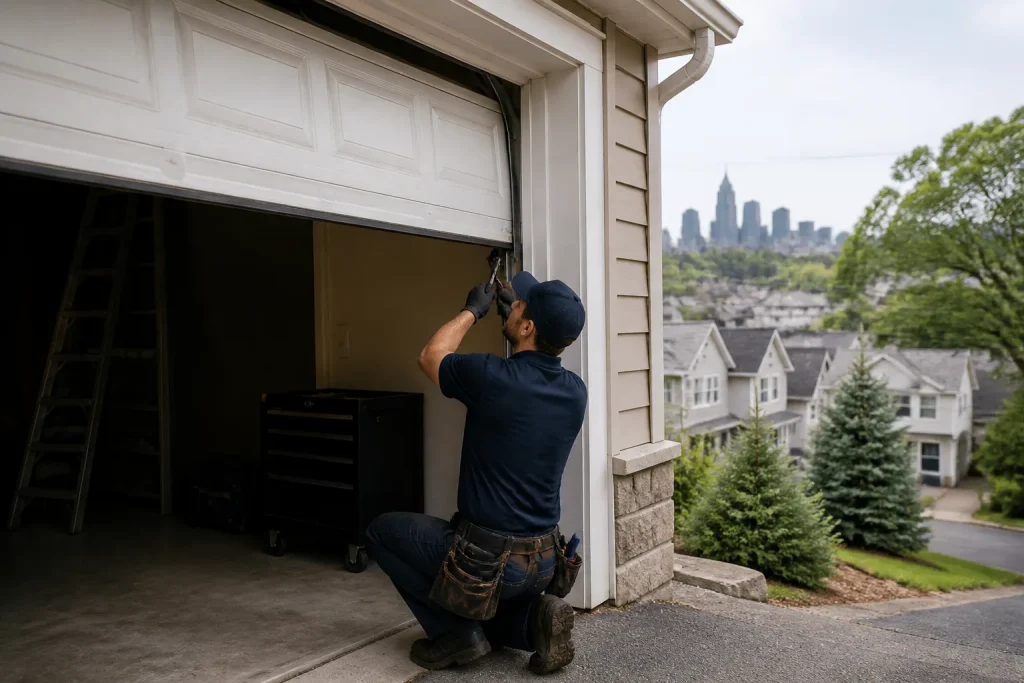
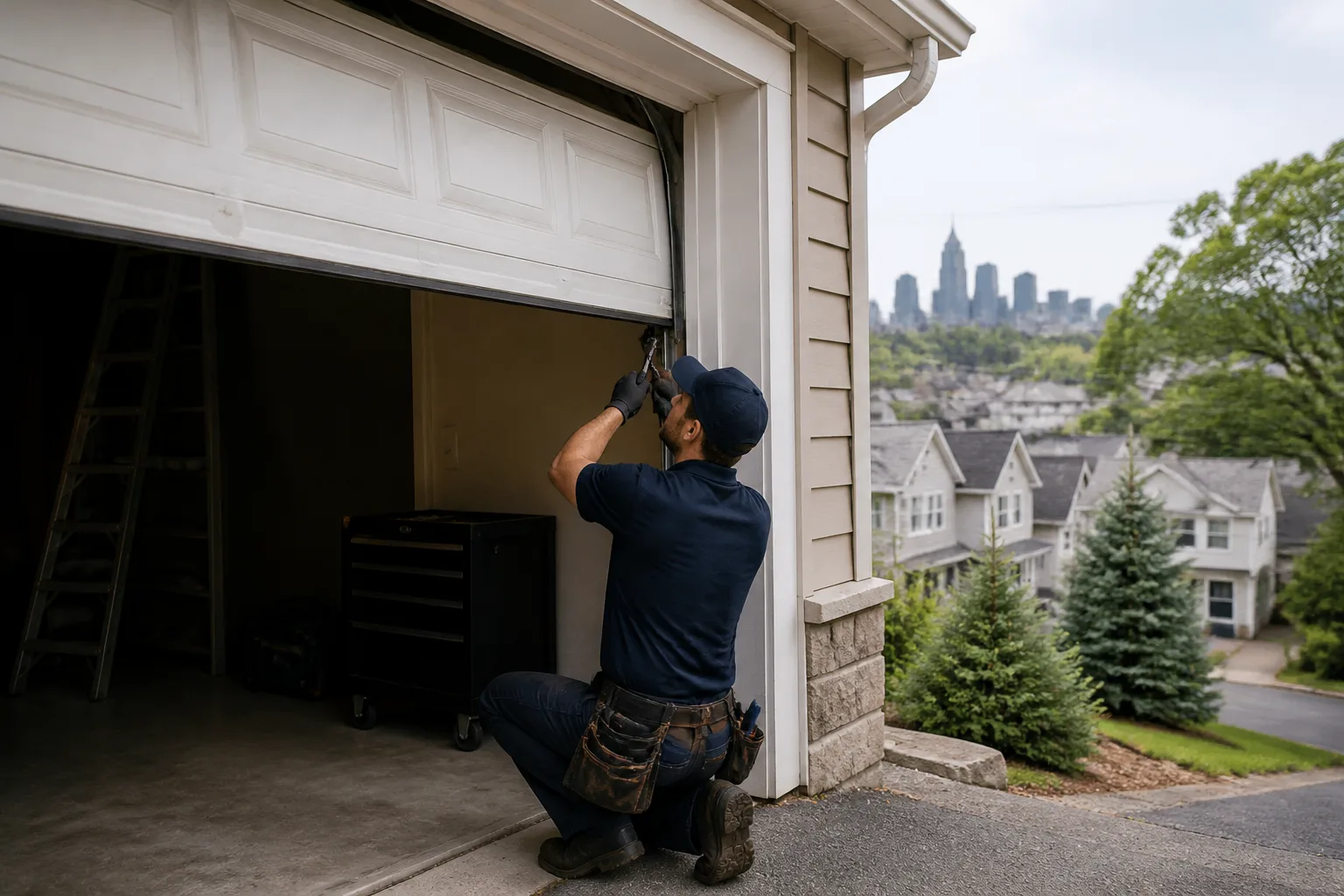
LiftMaster Garage Door Repair in The Heights: A Homeowner’s Guide
Most LiftMaster problems in The Heights aren’t hardware failures at all. They’re sensor misalignment from a garage that’s settled a little unevenly, or a MyQ module that dropped offline because winter turned your attached garage into a WiFi dead zone. That second one trips up more homeowners than any broken part we see. The good news: once you know which failure mode you’re dealing with, you’ll know whether it’s a four-minute reset or a call to a specialist. If you’d rather skip the guesswork, call (844) 325-8504 and we’ll sort it out.
Why Do LiftMaster Openers Fail So Often in The Heights?
LiftMaster is the most installed opener brand in The Heights area, so naturally it’s the brand we see most on repair calls. But frequency of installation isn’t the same as frequency of failure. Most of what goes wrong here traces back to local conditions rather than the hardware itself.
The Heights has a lot of older housing stock, and older attached garages weren’t built with WiFi in mind. Thick masonry walls, metal garage doors, and the simple distance from your router to the opener all conspire against a stable MyQ connection. Add a New Jersey winter and the temperature swings work on the building in ways that shift sensor brackets and stress door hardware.
The most common LiftMaster issues we encounter in The Heights homes break down like this:
- MyQ connectivity drops – the module loses its WiFi handshake, usually in cold weather or after a router change
- Safety sensor misalignment – brackets shift, or the original mounting position no longer lines up
- Error codes – the opener flashes a diagnostic pattern that tells you exactly what’s wrong, if you know how to read it
- Remote and keypad pairing failures – often a logic board issue, not a dead battery
- Travel limit drift – the door stops short or reverses before it should
None of these are unusual. What matters is diagnosing which one you’re facing before you start replacing parts.
What Do the Five Most Common LiftMaster Error Codes Actually Mean?
LiftMaster openers communicate through a diagnostic LED that flashes a set number of times, pauses, then repeats. Counting those flashes is the fastest way to know what’s wrong. Here are the five patterns we see most in The Heights, and what each one requires.
- One flash, repeated: Usually a wiring or safety sensor problem. Check that the sensor wires are intact and the lenses aren’t blocked. If the wires look fine, the sensor itself may have failed and need replacement.
- Two flashes: The safety sensors aren’t communicating with each other. Clean both lenses, check alignment, and confirm the receiving light is solid rather than blinking.
- Three flashes: A travel limit or force adjustment issue. The opener thinks the door is hitting something. This one often needs recalibration rather than a new part.
- Four flashes: The door isn’t reaching its programmed open or closed position. Could be a mechanical obstruction, a worn spring, or a limit setting that drifted.
- Five flashes: A logic board or motor problem. This is the one that most often means a part replacement, and it’s where a proper diagnosis saves you from buying the wrong component.
The key distinction: one through four are usually recalibration or a minor part fix. Five is the one that warrants a closer look before you commit to a repair. If your door’s problem isn’t the opener at all, you may be looking at garage door repair for the door and hardware instead.
How Do You Fix LiftMaster Sensor Alignment in Older Heights Garages?
Sensor alignment on a new garage follows the manual exactly. On an older Heights garage, it often doesn’t. The textbook mounting position assumes a square, settled opening, and plenty of The Heights homes have door frames that have shifted just enough to throw the standard angle off.
The safety sensors sit a few inches off the floor on each side of the door, facing each other. When they line up, both indicator lights stay solid. When they don’t, the door either won’t close or reverses the moment it starts down. In older garages, we regularly find sensors mounted at slightly different heights or angles because the original bracket placement no longer matches the frame.
What to check before assuming the sensor is broken:
- Wipe both lenses – cobwebs and dust cause more false trips than anything else
- Confirm both indicator lights are solid, not blinking
- Look for a bracket that’s been bumped or bent out of position
- Check that sunlight isn’t hitting the receiving sensor directly at certain times of day
If the lights stay solid but the door still reverses, the issue may be a loose wire or a failing sensor rather than alignment. At that point it’s worth having someone confirm the diagnosis rather than buying a replacement sensor that doesn’t solve the problem. Remember that sensors are the safety system, not an optional extra – don’t bypass them to force the door shut.
Why Does MyQ Keep Dropping Off in The Heights?
MyQ connectivity issues spike every winter in The Heights. Nine times out of ten the hardware is fine; the problem is signal. Attached garages in older New Jersey homes develop just enough of a WiFi dead zone to knock the module offline, especially once the exterior walls get cold and dense.
Before you assume the MyQ module has failed, check the basics:
- Confirm your home WiFi network name and password haven’t changed – a router replacement will disconnect MyQ every time
- Check the signal strength at the opener itself, not at your phone in the kitchen
- Look for new interference sources: a new metal storage rack, a replaced steel door, or a router that’s moved further away
- Power-cycle the opener and re-pair the module before assuming it needs replacement
If the module connects but drops again a week later, the issue is usually range, not the unit. A WiFi extender positioned between the house and the garage often solves it for good. That fix takes about four minutes once you know the signal is the culprit – and it’s far cheaper than replacing a MyQ module that was never broken. If re-pairing and better signal still don’t hold, we’ll take a look at the opener side with you through garage door opener repair.
When Is a LiftMaster Opener Worth Repairing vs. Replacing?
There’s no fixed rule, but model generation and age give you a solid starting point. Newer LiftMaster units with MyQ and battery backup are almost always worth repairing – the parts are available and the electronics are current. Older units without those features are a closer call.
A useful way to think about it:
- Worth repairing: A single failed component (sensor, logic board, capacitor) on a unit that otherwise runs quietly and has modern features
- Worth repairing: A connectivity or calibration issue on a current-generation opener
- Consider replacing: A unit that’s needed repeated motor or board repairs, or one that predates current safety features
Age matters here because New Jersey conditions are hard on openers. Cold winters, humidity swings, and constant daily use add up. A unit that’s been trouble-free for years can still reach a point where the repair cost climbs toward replacement territory. Our technicians have up to 14 years of experience reading that threshold, and we’ll tell you plainly when a repair no longer makes sense.
If a new opener is the right call, we can walk you through the options that fit your door through garage door installation. And if you’re comparing brands, LiftMaster, Craftsman, and Raynor all make solid openers – each has its own strengths depending on your door and how you use it.
LiftMaster Parts Availability in The Heights and How It Affects Your Repair
Parts availability is the quiet factor that decides how fast a repair actually happens. Some components are widely available and can be on hand quickly. Others – particularly logic boards and model-specific modules for older units – can add days to a repair while they’re sourced.
This affects your urgency decisions. If your door is stuck open and your home is exposed, a fast fix on the most common failure points matters more than waiting for a specialty board. A specialist who works on LiftMaster every week knows which parts are the usual suspects and can often diagnose without ordering blindly. That’s a big part of why working with a single-trade garage door company beats a generalist: we know the brand, we know the failure points, and we can tell you upfront whether your fix is a quick one or one that needs a part ordered.
When you’re deciding how to proceed, get a clear diagnosis first, then a written price for the parts and labor before anything is ordered or installed. A specialist should quote and confirm the price with you before the work begins – not after.
When to Call a Pro
Some LiftMaster fixes are genuinely DIY-friendly: re-pairing MyQ, wiping sensor lenses, power-cycling the opener. Others are not. Anything touching the springs, cables, or the mechanical counterbalance system is dangerous and belongs with a trained technician – those components store enormous tension, and a mistake can cause serious injury. If your door won’t move, makes a loud bang, or hangs unevenly, stop and call someone.
Related services in The Heights: beyond openers, we handle The Heights Garage Door Repair needs across the full lifecycle of your door, from a single sensor fix to a full replacement.
The Bottom Line
Most LiftMaster problems in The Heights aren’t catastrophic. The five error codes tell you whether you’re facing a reset, a recalibration, or a part replacement. MyQ drops are usually signal and interference, not broken hardware. Sensor misalignment in older garages is common and fixable. And the repair-versus-replace call comes down to model generation, age, and how many repairs a unit has already needed.
We work on LiftMaster every week and know the failure patterns in The Heights housing and climate well enough to tell you what you’re actually dealing with. If you’re in The Heights and need help, The Heights Garage Door Repair offers free estimates – call (844) 325-8504.
Frequently Asked Questions
Yes, in most cases. Power-cycling the opener, re-pairing MyQ, and clearing the travel limits are all homeowner-level resets. Count the diagnostic flashes first so you know what you’re resetting, then power-cycle and re-pair. If the same code returns after a reset, that’s your sign the fix is beyond a simple reset. Call (844) 325-8504 for an exact diagnosis – estimates are free.
Almost always the safety sensors. Either they’re misaligned, dirty, or one has failed. Check that both indicator lights are solid, wipe the lenses, and confirm nothing is blocking the beam. If the lights are solid and the door still reverses, a sensor or wire has likely failed. Call (844) 325-8504 and we’ll pinpoint it.
It depends on the failure, but a single sensor, remote, or wiring fix is typically the lowest-cost repair, a logic board or motor issue costs more, and a full opener replacement is the highest. We give you a written price before any work starts, so there’s no surprise on the invoice. Call (844) 325-8504 for an exact quote – estimates are free.
The local pro we connect you with is licensed and insured as New Jersey requires. Our technicians have up to 14 years of experience, and every call is garage-door specific – no divided attention across other trades. Call (844) 325-8504 to book a free estimate.
Written by the team at The Heights Garage Door Repair.
Need Garage Door Help?
Call The Heights Garage Door Repair - the local pro we connect you with is licensed and insured, here with fast after-hours help in The Heights.
(844) 325-8504